The World's Most Fascinating Desert Ecosystems
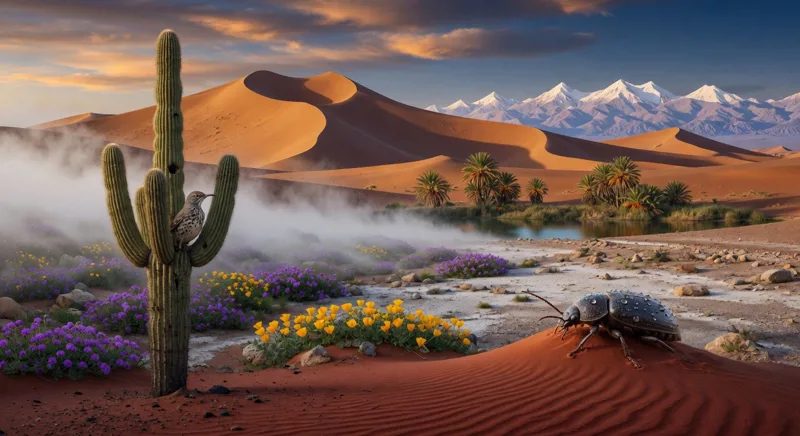
The world’s most fascinating desert ecosystems are far more than endless dunes. From fog-fed coastlines to freezing plateaus, deserts support remarkable plants, animals, and communities shaped by scarcity, temperature extremes, and surprising bursts of life.
What Makes a Desert Ecosystem?
A desert is generally defined as a region receiving no more than 25 centimeters of precipitation annually. Deserts may be hot, cold, coastal, semiarid, or located in the rain shadow of mountains. Together, they cover a significant portion of Earth’s land and contain specialized ecosystems adapted to limited water availability.[2][4]
Desert biodiversity often hides in plain sight. Plants may remain dormant for months, animals may emerge only after sunset, and entire food webs can become active after a rare rainfall event. Temperature swings are also dramatic: dry air allows heat to escape quickly after dark, creating cold nights even after intensely hot days.[5]
1. The Atacama Desert: Earth’s Extreme Coastal Desert
Stretching along northern Chile, the Atacama Desert is widely regarded as the driest non-polar desert on Earth. Some areas can pass decades with little or no measurable rainfall, yet coastal fog provides moisture for specialized organisms.[4]
This fog supports lichen, mosses, insects, and plants that capture tiny droplets from the air. In especially rare wet years, dormant seeds can bloom across the landscape, creating the spectacular phenomenon known as a desert flower bloom.
The Atacama is also a powerful example of how geology influences desert life. Mineral-rich soils, salt flats, volcanic formations, and fog-covered hills create several microhabitats within one extremely arid region.
2. The Namib Desert: Ancient Dunes and Fog Harvesters
The Namib Desert, extending along the southwestern coast of Africa, is one of the world’s oldest deserts. Its famous red dunes and gravel plains appear nearly lifeless, but the ecosystem contains beetles, reptiles, plants, and mammals with highly specialized survival strategies.[1]
One of its most intriguing adaptations belongs to fog-harvesting beetles. By positioning their bodies to collect moisture from coastal fog, they can obtain water in an environment where rainfall is exceptionally limited.
The Namib’s dune ecosystem also demonstrates how small organisms influence the wider food chain. Beetles and other invertebrates become food for lizards, birds, and mammals, while hardy grasses and shrubs stabilize selected areas of sand.
3. The Sonoran Desert: A Hot Desert Full of Seasonal Life
The Sonoran Desert spans parts of the southwestern United States and northwestern Mexico. Unlike many arid regions, it receives rainfall during two seasons, helping support unusually rich plant and animal diversity.[6]
The iconic saguaro cactus is its best-known species. Its pleated stem expands to store water, while its shallow but extensive root system quickly absorbs rain. Saguaros also provide nesting sites and food for birds, bats, and insects.
Other Sonoran Desert wildlife includes coyotes, desert tortoises, roadrunners, and javelinas. Many species avoid the hottest conditions by sheltering underground, resting beneath vegetation, or becoming active at night.
4. The Sahara: Dunes, Oases, and Hidden Waterways
The Sahara is the largest hot desert on Earth, but it is not a single uniform habitat. Its ecosystems include shifting dunes, rocky plateaus, gravel plains, mountain ranges, salt flats, and oasis environments.[3]
Oases create concentrated pockets of biodiversity. Date palms, freshwater pools, insects, reptiles, birds, and mammals can gather around underground water sources. These isolated habitats are especially important because they connect desert wildlife with food, shade, and drinking water.
In the dunes, animals such as fennec foxes and monitor lizards must cope with loose sand, intense heat, and scarce prey. Their adaptations include nocturnal activity, large ears that release heat, and behavioral strategies that reduce water loss.
5. The Gobi Desert: A Cold Desert of Extremes
The Gobi Desert stretches across parts of Mongolia and northern China. It is a cold desert, shaped by continental climate, high elevation, and rain-shadow effects from surrounding mountains and plateaus.[3][4]
Winter temperatures can plunge far below freezing, while summer heat may become intense. Rather than endless sand, the Gobi contains rocky terrain, sparse grasslands, dry valleys, and fossil-rich landscapes.
Wild Bactrian camels, snow leopards, saiga antelope, and Gobi bears illustrate the resilience of cold-desert wildlife. Many species must survive both water scarcity and severe seasonal temperature changes.
How Desert Plants and Animals Survive
Desert organisms use a combination of physical, behavioral, and biological adaptations:
- Water storage: Cacti and other succulents store moisture in stems, leaves, or roots.
- Deep or widespread roots: Some plants reach underground water, while others rapidly absorb rainfall near the surface.[2][5]
- Reduced leaves: Small leaves, spines, or waxy coatings limit evaporation.
- Nocturnal behavior: Many mammals, reptiles, and insects avoid daytime heat by becoming active after sunset.
- Seasonal dormancy: Seeds and animals can remain inactive until rain creates temporary food and water supplies.
- Efficient body systems: Species such as camels conserve water through specialized physiology and heat management.
Threats to Desert Ecosystems
Desert environments are resilient, but they can also be fragile. Climate change may increase heat, drought, wildfire risk, and pressure on slow-growing plants. Invasive grasses can alter fire patterns, while excessive groundwater extraction threatens oasis habitats and wildlife.[1][2][4]
Overgrazing, off-road vehicle use, mining, pollution, and poorly managed tourism can damage soil crusts and vegetation that may take decades to recover. Conservation strategies include protected areas, sustainable grazing, careful water management, native-plant restoration, and habitat monitoring.
Why These Deserts Matter
The world’s most fascinating desert ecosystems reveal how life can flourish under extreme limitations. They contain unique species, store cultural and geological history, support local communities, and provide valuable insight into adaptation and climate resilience.
Next time a desert landscape looks empty, look closer. A beetle collecting fog, a cactus sheltering a bird, or a dormant flower waiting for rain may be evidence of one of Earth’s most inventive and interconnected ecosystems.
References
You May Also Like
 Travel
When Tourism Helps Protect Fragile Places
 Travel
Citizen Science Trips That Welcome Travelers
 Travel
How to Choose Responsible Nature Experiences