Ancient Trade Routes You Can Still Follow
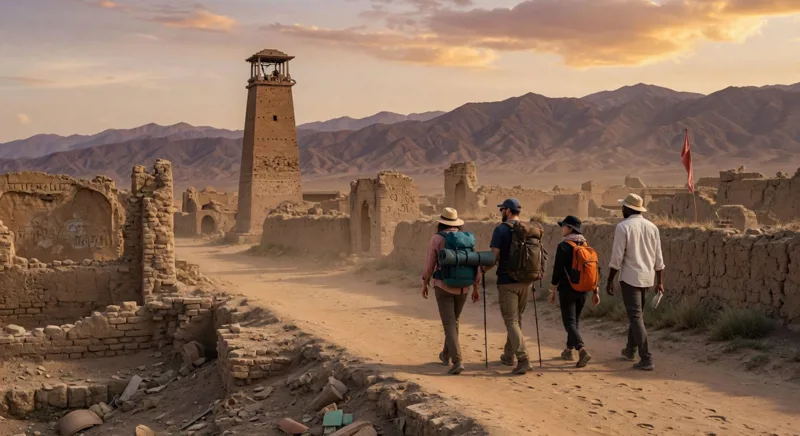
Ancient trade routes you can still follow offer more than beautiful scenery: they connect travelers with vanished empires, living cultures, and the everyday movement of silk, spices, metals, and ideas. From the Silk Road to Europe’s medieval pilgrimage paths, these historic journeys remain accessible through museums, archaeological sites, hiking trails, and modern roads.
1. The Silk Road Through China and Central Asia
The Silk Road was never a single highway. It was a vast network linking China, Central Asia, the Indian subcontinent, Western Asia, and the Mediterranean. One of its best-preserved sections is the Chang’an–Tianshan Corridor, which stretches from ancient Chang’an—modern Xi’an—through China toward Kazakhstan and Kyrgyzstan.
UNESCO recognizes this corridor as a World Heritage route containing ancient cities, trading settlements, Buddhist cave temples, mountain passes, beacon towers, and sections of the Great Wall.[1][3] The broader corridor extends roughly 5,000 kilometers, while its connected route network reached about 8,700 kilometers.[1]
Highlights to explore
- Xi’an, China: Begin near the ancient capital and visit the Muslim Quarter, the Giant Wild Goose Pagoda, and the historical sites associated with Chang’an.
- Dunhuang, China: Explore the Mogao Caves, Yumen Pass, and desert landscapes that once guided caravans.
- Kashgar, China: Visit its historic markets and old neighborhoods, where Central Asian and Chinese traditions meet.
- Almaty and the Zhetysu region: Use Kazakhstan as a gateway to Silk Road settlements, archaeological sites, and mountain valleys.
- Kyrgyzstan: Follow sections near the Chuy and Talas valleys, where traders once crossed between major Central Asian centers.
This is one of the best ancient travel routes for visitors who want a combination of history, architecture, food culture, and dramatic landscapes. Because the route crosses several countries, plan carefully around visas, border rules, seasonal weather, and transportation.
2. The Via Francigena: From Canterbury to Rome
The Via Francigena is one of Europe’s most rewarding historic walking routes. Originally used by pilgrims and merchants, it connected Canterbury in England with Rome in Italy. The full journey covers approximately 1,700 kilometers, although many travelers choose shorter sections.[2]
Today, the route passes through villages, vineyards, mountain landscapes, medieval towns, and historic cities. Popular stages include the French countryside, the Great St Bernard Pass, Tuscany, and the approach to Rome.
Why walk the Via Francigena?
- It offers established walking stages and historic waymarks.
- Travelers can complete a weekend section or plan a longer pilgrimage.
- Small towns provide access to local food, churches, museums, and traditional accommodations.
- The route combines cultural travel with low-impact hiking.
The best time to walk depends on the section. Spring and autumn are often comfortable for lowland stages, while mountain sections may require careful planning because of snow and changing conditions. Comfortable footwear, offline maps, and advance accommodation planning are essential.
3. Roman Roads Across Europe
Roman roads formed one of the ancient world’s most sophisticated transportation systems. Although many original surfaces have disappeared, modern roads, footpaths, and archaeological parks still reveal their routes.
In Britain, portions of roads such as Watling Street and the Fosse Way can be explored through present-day villages, field paths, and city streets. In Italy, France, Spain, and the Balkans, Roman roads connect travelers with amphitheaters, bridges, military settlements, aqueducts, and old market towns.
Great Roman-road experiences
- Via Appia, Italy: Walk or cycle sections of Rome’s ancient road past tombs, catacombs, and countryside ruins.
- Hadrian’s Wall region, England: Combine Roman military history with long-distance walking and rural scenery.
- Via Domitia, France: Trace an ancient route through southern France toward the Mediterranean.
- Roman Hispania: Explore surviving bridges, roads, and settlements across Spain.
Roman routes are particularly accessible for independent travelers because many lie near modern towns and public transportation. A regional museum pass or archaeological-site pass can also make a multi-stop itinerary easier to organize.
4. The Amber Road in Central and Eastern Europe
The Amber Road linked Baltic coastal regions with the Mediterranean world. Traders moved amber southward, while wine, glass, ceramics, and luxury goods traveled north. Rather than following one fixed track, the route consisted of changing paths through rivers, forests, and settlements.
Modern travelers can explore Amber Road heritage in Poland, the Czech Republic, Slovakia, Austria, Hungary, Slovenia, and northern Italy. Museums in Baltic cities explain the importance of amber, while Roman archaeological sites farther south show how trade shaped frontier communities.
This route suits travelers interested in archaeology, jewelry history, Roman culture, and regional museums. It can also be adapted into a flexible road trip rather than a single continuous hike.
5. The Spice Routes of the Indian Ocean
The ancient spice trade was largely maritime, connecting Southeast Asia, India, the Arabian Peninsula, East Africa, and the Mediterranean. Sailors used seasonal monsoon winds to transport pepper, cloves, cinnamon, cardamom, textiles, ceramics, and precious stones.
No single modern trail reproduces the entire route, but several destinations preserve its history:
- Kochi, India: Explore historic trading neighborhoods, spice markets, and port heritage.
- Zanzibar, Tanzania: Visit Stone Town, whose architecture reflects centuries of Indian Ocean commerce.
- Muscat, Oman: Learn about Arabian maritime trade and connections across the Indian Ocean.
- Malacca, Malaysia: Discover a historic port shaped by merchants from China, India, Arabia, and Europe.
- Alexandria, Egypt: Connect Mediterranean commerce with the overland and maritime networks of the ancient world.
These destinations work especially well as a history-focused city itinerary. Local food tours can add another dimension, revealing how trade routes changed regional cuisines and introduced ingredients across continents.
How to Plan an Ancient Trade Route Journey
- Choose a theme: Decide whether your priority is hiking, archaeology, food, architecture, or cultural history.
- Follow a section, not the entire route: Ancient networks were enormous, and a focused itinerary usually provides a richer experience.
- Check current travel conditions: Border rules, transport schedules, permits, and site access can change.
- Travel in the right season: Deserts, high mountain passes, and exposed walking routes can become hazardous during extreme weather.
- Respect living communities: These routes are not only archaeological attractions; they pass through homes, religious sites, and working markets.
- Use local guides where appropriate: A knowledgeable guide can explain historical layers that are easy to miss when traveling independently.
Follow History at Your Own Pace
Ancient trade routes you can still follow bring the past into the present without requiring a single style of travel. Walk a Tuscan section of the Via Francigena, explore Silk Road cities in Central Asia, cycle beside Roman ruins, or trace spice-trade heritage through Indian Ocean ports.
The most meaningful journeys do not simply recreate an old map. They reveal how commerce carried languages, religions, technologies, foods, and ideas across borders. Choose one region, slow down, and let the route—not just the destination—tell the story.
You May Also Like
 Travel
When Tourism Helps Protect Fragile Places
 Travel
Citizen Science Trips That Welcome Travelers
 Travel
How to Choose Responsible Nature Experiences